
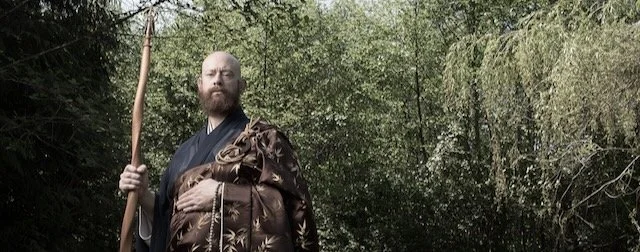
A note on language: I use the word apprentice rather than student deliberately. "Student" suggests a person who is acquiring knowledge — sitting at a distance from a subject that is being learned — taking notes, accumulating intellectual understanding. That's not what this is. Yes, learning is a part of apprenticeship, but being a student is not the same as being an apprentice. An apprentice is immersed in the work, a part of the work — interwoven with the craft itself, shaped by proximity, formed through practice over time. What changes in this training is not primarily how much or what you know. It is how clearly you are able to manifest who you are. That is apprenticeship.
WHAT IS Zen Apprenticeship?
Apprenticeship with me is a formal training relationship in the Rinzai Zen tradition.
Apprenticeship is not a course. It's not therapy. The teacher-apprentice relationship isn't a subscription to content nor a membership in a community — although it may be a doorway to all of those things if you choose them.
Apprenticeship is a commitment between a teacher and an apprentice, with real obligations on both sides, entered into consensually, intentionally, and with eyes open.
If you're looking for a different kind of container — a guided conversation rooted in Zen or Buddhism, periodic contact with a teacher, or support for your practice without the full structure of formal training — Zen mentorship is also available. Mentorship has its own shape and value, and it is fundamentally different from apprenticeship.
ZENWEST & MONARCH
Zenwest Buddhist Society is a temple sangha — a community of practitioners gathered around a shared practice, a common liturgy, and the forms of the Rinzai tradition. As Abbot, I have been charged by Zenwest to administer and transmit the teachings, formation, and training. The path into Zenwest membership runs through that administration.
Monarch is the practical vehicle through which I deliver these teachings: the courses, the training relationships, the meeting fees, the booking and payment infrastructure. This arrangement is intentional on both sides. Zenwest's position is that the demands of training — time, cost, and effort — belong with those who seek it, rather than being carried collectively by the Zenwest membership.
Running courses and training through Monarch grants me autonomy over how courses are designed, delivered, and remunerated. The fees — apprenticeship, courses, meetings — are what sustain me both as Abbot and as a human being, and make it possible for Zen teaching to be a core focus in my life, rather than something I do outside of "working hours".
The RAPP — Zenwest's Religious Authorization Policy and Procedure — is the governance framework that defines the full arc of training and ceremony in this tradition, from formation, through Jukai and Ordination, to teaching authorization. As Abbot, I am responsible for administering and maintaining it. The RAPP path is available to those who are both Zenwest members and formal apprentices.
You can choose to be my apprentice through Monarch without being a Zenwest member — in a formal training relationship, with full access to dokusan, while practising on your own or as part of another sangha. But to enter onto the Zenwest RAPP path, both Zenwest membership and apprenticeship are required.
THE Teacher-APPRENTICE RELATIONSHIP
Entry into formal apprenticeship is marked by the Shōken ceremony — a teacher-apprentice ceremony that has been part of this lineage for centuries. From that point, you are my apprentice. Not a client. Not a participant. An apprentice.
This relationship asks consistency of you. Not perfection — consistency. Showing up to your practice, to your meetings with me, to the honest work of your own life. The relationship is not contingent on your being good at Zen. It is contingent on your genuine engagement.
From my side: honest teaching. Not comfort. Not cheerleading. I have walked this path for over thirty years and I will tell you what I actually see — in your practice, and in you.
Formal apprenticeship opens the possibility — when you are also a Zenwest member — of the RAPP training path.
Apprenticeship is also the gate to dokusan — the formal interview with the teacher. This is where the real work of formation happens: not instruction, but direct encounter. It is available to formal apprentices and is what distinguishes this relationship from mentorship or sangha membership.
$75 + GST per month, which maintains the relationship.
Individual sessions: $130 + GST per 45-minute session, scheduled as your training calls for.
RAPP — LEVEL 1 (Practice Council)
This is the level at which formal RAPP engagement begins. The apprentice has taken the precepts (Jukai) and is learning to hold the forms — officer roles in the zendo, supporting practitioners newer to the path, beginning to understand what it means to carry the practice on behalf of others as well as oneself. The training relationship intensifies accordingly.
The monthly meeting — dokusan, formation work, and where appropriate the introduction of sanzen (koan practice) — is the floor, not the ceiling.
$170 + GST per month — the full monthly rate at this level, with the base apprenticeship relationship and one regular, expected meeting included. Additional sessions at $130 + GST.
RAPP — LEVEL 2 (Elder / Lay Teacher)
By the time an apprentice reaches Level 2, something has shifted. They are no longer primarily receiving formation — they are actively transmitting it. Elders, Junior Lay Teachers, and Lay Teachers teach courses, lead practice groups, assist at ceremonies, and represent Zenwest in settings where I am not present. If I am away, a Level 2 apprentice may give the Dharma talk. They may be sent to speak at another temple, church, or Zen centre as a representative of this lineage.
That is not a small thing. When someone stands up under this lineage's name, my reputation — and the integrity of the transmission — travels with them. For a person who is actively taking responsibility within the temple and sangha, the increased meeting frequency at this level offers time and space for specific support and guidance to do this well — and two meetings a month, dokusan and sanzen as the training requires, are where that formation is held.
$265 + GST per month — the full monthly rate at this level, with the base apprenticeship relationship and two regular, expected meetings included. Additional sessions at $130 + GST.
ORDAINED TRAINING (Novice, Junior, Priest)
The ordained path — entered through Tokudō, the leaving-home ceremony — is the deepest commitment the tradition offers. It is not a package to be selected. It is arrived at through the relationship, through discernment, and at my invitation.
The monthly apprenticeship fee remains a baseline — at minimum the Level 2 rate. Meeting frequency beyond that, and any additional costs, are determined in direct conversation between us. Sessions are $130 + GST each. The RAPP requires participation in all communal practice unless given leave — this is formation as a way of life, not a monthly subscription.
If you are discerning the ordained path, bring that conversation directly to me.
COMMITMENT & COMMUNICATION
Becoming an apprentice means entering a reciprocal relationship — and reciprocal relationships have obligations on both sides.
Life moves. Finances tighten. The path takes unexpected turns. An apprentice's circumstances will change over the course of a training relationship — sometimes significantly. None of that is a problem. What matters is that it is communicated.
If money gets tight, say so. If something in the relationship isn't working, name it. If your path is shifting and you're not sure this is still the right direction, bring that conversation to me rather than letting it quietly dissolve. The relationship can weather difficulty. It cannot hold what it cannot see.
Ghosting — going silent, missing sessions without contact, letting payments lapse without a word — these are not neutral acts. They have real impacts on a human teacher who has made a relational commitment to you. And the standard is reciprocal: if something on my end is affecting the relationship, you'll hear it from me directly.
This is what the relationship asks of both of us — honest contact, even and especially when it's uncomfortable.
For apprentices on the RAPP path
Apprentices who have been authorized to a position within the RAPP — who hold a title, who are offering peer meetings, who carry any form of representation of this lineage — carry an additional responsibility.
If you find yourself wanting to step back from that role, my expectation is that we meet, we talk it through honestly, and we arrive at a mutually understood path forward together. This is not about holding anyone to a commitment they can no longer keep — rather, it is honouring the weight of what was entered into: the people who may be in your care, the sangha that has acknowledged you, and the lineage you have been authorized to represent.
Life circumstances change. There is wisdom in knowing when it's time to step back, and to do so with integrity is always possible. A door left well stays open.
PRACTICE & INTENSIVES
Dharma talks at public events, and during intensives (zazenkai/sesshin), are offered openly to everyone in attendance. Most Dharma talks are recorded, and the recordings may be made available afterwards.
Dokusan — formal interview — is reserved for formal apprentices. Dokusan is where the real work of formation happens, and it requires the formal relationship to hold it properly.
At intensives, attendees who are not formal apprentices will attend peer meetings with senior apprentices. These are a regular, supportive offering of pastoral care, a check-in, and a place to be seen during intensive practice.
ON DANA
Dana — the practice of offering — is welcome here. It comes after the basic exchange is honoured, not instead of it. If, having paid your membership, your session fees, your event costs, you find yourself wanting to offer more — you are warmly invited to do so. This is dana: generosity rooted in gratitude, freely given without expectation.
ON CAPACITY
Apprenticeship is capped at twelve. Based on experience, that's about the limit of what I can sustain at the depth this training demands — and ensures adequate dokusan time for each apprentice during intensives.
HOW TO BEGIN
Whether you feel ready to step into apprenticeship, or you're wanting to discern a path of practice that's appropriate for you — the first step is a conversation. There are no obligations, commitments, or decisions expected or required.
Kōsen Eshū, Oshō — Abbot, Zenwest Buddhist Society